Inside the profession
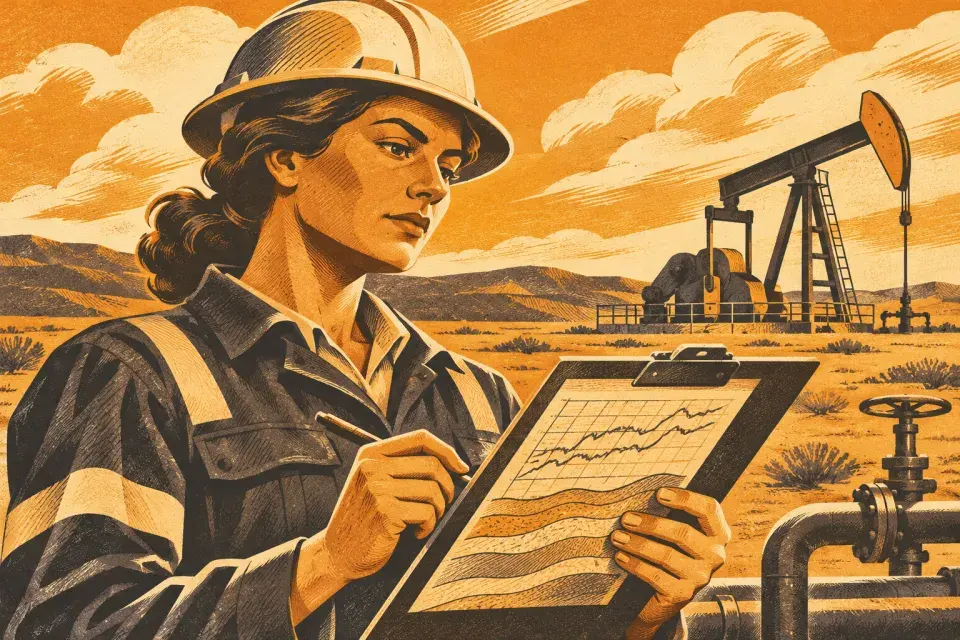
Much of the decision depends on what cannot be seen directly underground. Petroleum engineers use geological information, measurements, and production records to estimate how a reservoir will behave. They revise forecasts when a well performs differently from what the team expected.
What a day can involve
- Interpret reservoir information with geoscientists and build production forecasts.
- Evaluate proposed drilling or recovery projects against cost, safety, and site constraints.
- Track performance against the forecast and report what new measurements change.
Where you might work
Energy company offices, consulting firms, and field operations.
Where you can work
Industries employing this occupation in the United States, from the 2025 BLS employment matrix.
- Oil and gas extraction
- Support activities for mining
- Engineering services
- Management of companies and enterprises
- Management, scientific, and technical consulting services
- Petroleum and coal products manufacturing
All reported industry sectors
- Mining, quarrying, and oil and gas extraction
- Professional, scientific, and technical services
- Management of companies and enterprises
- Manufacturing
- Transportation and warehousing
- Government, excluding state and local education and hospitals
- Utilities
- Finance and insurance
Your path in the United States
A bachelor’s degree in petroleum engineering or a related engineering subject is typical. Look for coursework in geology and reservoir behaviour alongside design and practical experience.
Entry requirements · U.S. Bureau of Labor Statistics
Training to explore
The Colorado School of Mines catalog lays out the bachelor’s curriculum. Look for the sequence connecting geology, reservoir engineering, and design.
Petroleum EngineeringColorado School of MinesWhat to budget for
Ask whether field courses require travel and whether work terms change the length of the degree. Compare the full calendar as well as tuition per term.
Explain a forecast revision
Invent a four-month production forecast and four actual totals. Make the final two totals lower than expected. Plot both lines and list two questions you would ask before updating the next month’s forecast.
Could you explain what changed while leaving room for uncertainty?
Sources and context
The U.S. figures refer to petroleum engineers (SOC 17-2171). Field crews that operate drilling equipment are counted separately.
BLS projects 400 net new U.S. jobs from 2025 to 2035. Openings to replace people who leave the occupation are a separate measure. BLS projections
- U.S. Bureau of Labor Statistics · Duties and work settings
- U.S. Bureau of Labor Statistics · Entry requirements
- U.S. Bureau of Labor Statistics · National median wage
- U.S. Bureau of Labor Statistics · Employment outlook
- Where you can work
- Colorado School of Mines · Petroleum Engineering