Inside the profession
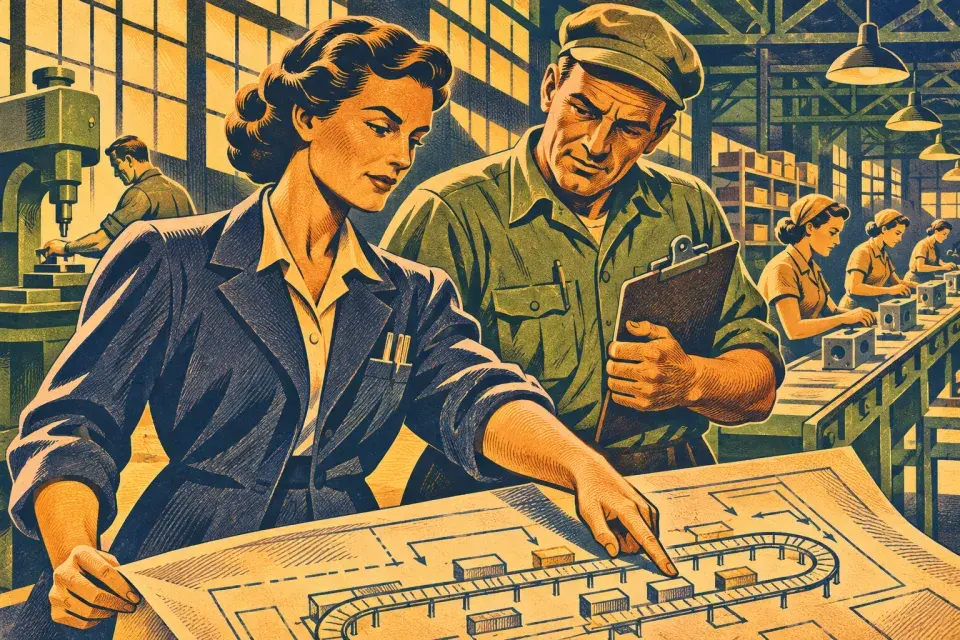
A busy workstation can keep the whole line waiting even when the other stations have spare time. Industrial engineers measure the flow of work, check what causes delays and compare changes before recommending one. The same approach can apply to a factory floor or a service operation.
What a day can involve
- Observe a process and collect data on time, quality and capacity.
- Compare layouts, production schedules or staffing arrangements.
- Work with operators and managers to introduce and evaluate a process change.
Where you might work
Factories, distribution operations, service organizations and engineering offices.
Where you can work
Industries employing this occupation in the United States, from the 2025 BLS employment matrix.
- Aerospace product and parts manufacturing
- Engineering services
- Semiconductor and other electronic component manufacturing
- Machinery manufacturing (3331,2,4,9)
- Navigational, measuring, electromedical, and control instruments manufacturing
- Motor vehicle parts manufacturing
All reported industry sectors
- Manufacturing
- Professional, scientific, and technical services
- Wholesale trade
- Management of companies and enterprises
- Administrative and support and waste management and remediation services
- Transportation and warehousing
- Construction
- Government, excluding state and local education and hospitals
- Mining, quarrying, and oil and gas extraction
- Information
- Other services (except public administration)
- Utilities
- Retail trade
- Finance and insurance
- Educational services; state, local, and private
- Healthcare and social assistance
- Arts, entertainment, and recreation
- Real estate and rental and leasing
Your path in the United States
A bachelor’s degree in industrial engineering or a related engineering field is typical. Look for assignments that use data from an actual process so you can compare a model with what happens on the floor.
Entry requirements · U.S. Bureau of Labor Statistics
Training to explore
Purdue’s industrial engineering major looks at how systems operate. Read its curriculum with a particular factory or service process in mind.
Industrial EngineeringPurdue UniversityWhat to budget for
Compare the facilities and project work included in tuition. Ask whether an industry placement adds a term or requires travel to a site outside the campus area.
Follow a batch of envelopes
Imagine a team addressing, checking and sorting envelopes. Assign a different time to each step and sketch where envelopes would queue. Change one time and see whether the wait moves elsewhere.
Which change helped the entire process rather than one workstation alone?
Sources and context
The U.S. figures use the industrial engineer row (SOC 17-2112). Health and safety engineers have a separate row.
BLS projects 45,400 net new U.S. jobs from 2025 to 2035. Openings to replace people who leave the occupation are a separate measure. BLS projections
- U.S. Bureau of Labor Statistics · Duties and work settings
- U.S. Bureau of Labor Statistics · Entry requirements
- U.S. Bureau of Labor Statistics · National median wage
- U.S. Bureau of Labor Statistics · Employment outlook
- Where you can work
- Purdue University · Industrial Engineering