Inside the profession
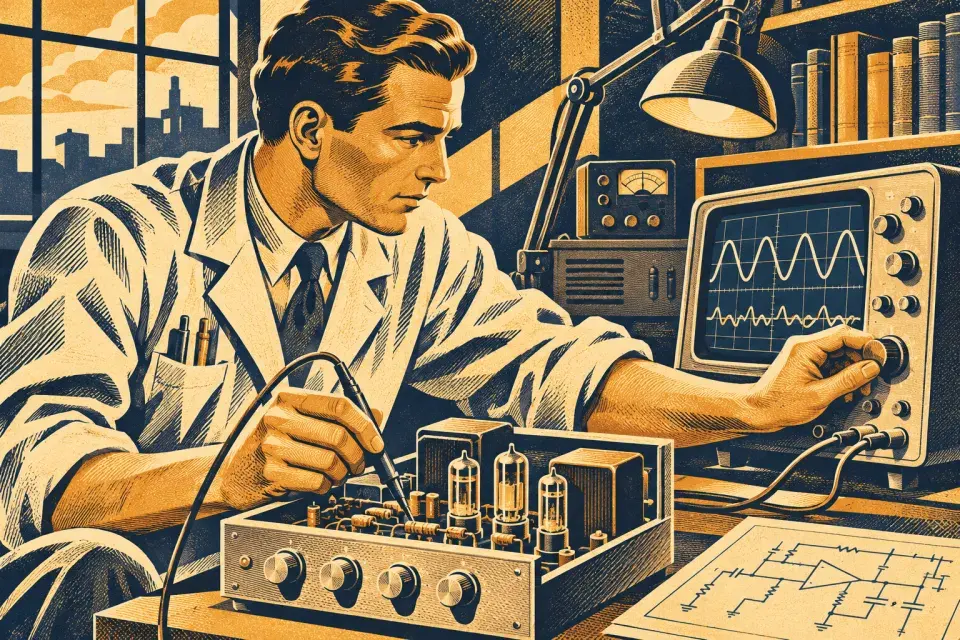
A sensor can deliver a signal too small or noisy to use directly. An electronics engineer designs the circuits that turn it into usable information. Work can include communications equipment, instruments or control devices, from the first schematic to tests on a manufactured unit.
What a day can involve
- Choose components and draw circuit schematics for a design.
- Measure prototype behaviour and compare it with the intended signal response.
- Explain design changes to people producing or testing the device.
Where you might work
Electronics manufacturers, design laboratories and engineering service firms.
Where you can work
Industries employing this occupation in the United States, from the 2025 BLS employment matrix.
- Federal government, excluding postal service
- Telecommunications
- Semiconductor and other electronic component manufacturing
- Research and development in the physical, engineering, and life sciences
- Engineering services
- Navigational, measuring, electromedical, and control instruments manufacturing
All reported industry sectors
- Manufacturing
- Professional, scientific, and technical services
- Government, excluding state and local education and hospitals
- Information
- Wholesale trade
- Management of companies and enterprises
- Administrative and support and waste management and remediation services
- Construction
- Educational services; state, local, and private
- Other services (except public administration)
- Transportation and warehousing
- Utilities
- Real estate and rental and leasing
- Mining, quarrying, and oil and gas extraction
- Healthcare and social assistance
Your path in the United States
A bachelor’s degree in electronics, electrical engineering or a related field is typical. Look at which courses require you to design, build and measure a circuit yourself.
Entry requirements · U.S. Bureau of Labor Statistics
Training to explore
Illinois publishes its electrical engineering course sequence. Check how the required foundations lead into electronics electives.
Electrical engineering curriculumUniversity of Illinois Urbana-ChampaignWhat to budget for
Ask whether students can borrow test instruments outside scheduled lab hours. Include any required component kits and project materials when comparing programs.
Trace a sensor reading
Draw the path from a fictional temperature sensor to a display. Label what each stage receives and passes on. Imagine the display always reads zero and write one question about each stage.
Which measurement would help you decide where the reading changed?
Sources and context
The U.S. figures are for electronics engineers, except computer (SOC 17-2072). Computer hardware engineers have their own row.
BLS projects 3,600 net new U.S. jobs from 2025 to 2035. Openings to replace people who leave the occupation are a separate measure. BLS projections
- U.S. Bureau of Labor Statistics · Duties and work settings
- U.S. Bureau of Labor Statistics · Entry requirements
- U.S. Bureau of Labor Statistics · National median wage
- U.S. Bureau of Labor Statistics · Employment outlook
- Where you can work
- University of Illinois Urbana-Champaign · Electrical engineering curriculum